
Monthly Newsletter: March 2026
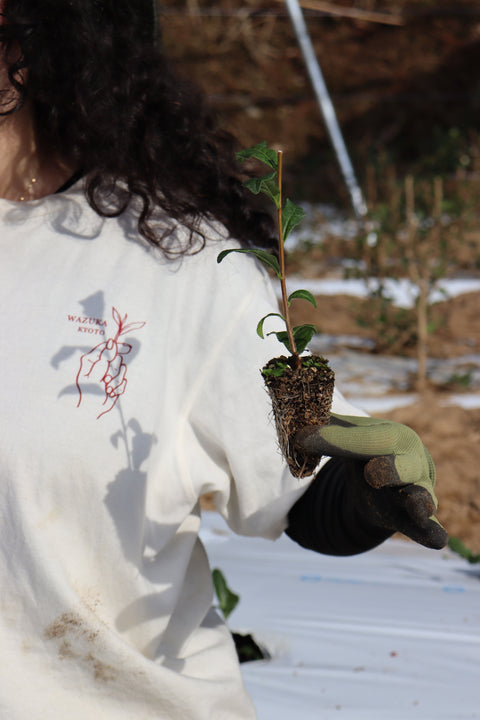
- 1. Replanting 4,500 "Ujihikari" Saplings - Daiki T.
- 2. Learning the Art of Yoshizu at Lake Biwa - Emma C.
- 3. The Culture of the Four Seasons in Tea Ceremony - Seiya H.
- 4. Representative Types of Tea Bowls - Misato T.
- 5. Fertilizer Management in Tea Cultivation - Hiroki A.
- 6. About Matcha Sweets - Sora N.

Replanting 4,500 "Ujihikari" Saplings: A Decade-Long Investment in Kyoto’s Heritage

In March 2026, we completed the replanting of 4,500 "Ujihikari" saplings. Ujihikari is a cultivar unique to Kyoto. Among the various teas we offer for tasting at d:matcha, it is consistently popular for its exceptionally low bitterness and astringency, replaced instead by a profound, rich umami flavor. Its name, combining "Uji" (the heart of Japanese tea) and "Hikari" (light), is also widely embraced for its beautiful and clear meaning. As a Kyoto-exclusive cultivar, it is legally restricted to cultivation within the prefecture—a fact we hold in high regard as we commit to the long-term future of the tea industry.
This year’s project involved two plots: one where we cleared an old seedling garden adjacent to Ujihikari trees planted three years ago, and another where we reclaimed and cleared an abandoned tea garden that had been neglected for seven years.
Replanting is a long-term investment. To be honest, there is no guarantee of an immediate return. For a March 2027 planting, we must order seedlings by January 2026. This is followed by a grueling process of uprooting old trees, tilling the soil, and preparing the land before finally hand-planting each sapling under mulch in mid-March.
It takes five to six years for a sapling to mature. We do not expect a 100% yield until around 2033. Until then, the work is endless: fertilizing, pruning, and above all, weeding. Because young trees are small and spaced out, weeds grow far more aggressively than in mature gardens. Since d:matcha practices organic farming, we use no herbicides. The physical toll of hand-weeding in the sweltering summer heat is immense.
Yet, as the global popularity of matcha rises and green tea powders are produced worldwide, we believe it is vital to preserve the authentic characteristics of Kyoto tea. We are committed to traditional methods: using Kyoto cultivars, shaded cultivation (tana), processing tencha in brick ovens, and stone-grinding. By combining these labor-intensive techniques with organic certification, we aim for world-class quality.
From a short-term financial perspective, such an undertaking is difficult to justify. However, leveraging our strength as an owner-operated company, we will continue to invest in new cultivars and traditional techniques every year, ensuring the legacy of Kyoto tea for the next generation.


Learning the Art of Yoshizu at Lake Biwa

Last month, Daiki-san, Hiroki-san, and I headed to the shores of Lake Biwa. Japan’s largest lake, to learn more about Yoshizu. Yoshizu are traditional woven screens made from reeds, or yoshi, which are used for shading high-grade teas like tencha and gyokuro. In Japanese tea cultivation, shading is a critical process where tea bushes are covered for multiple weeks before harvest to block out direct sunlight. This stress forces the plants to produce more chlorophyll and L-theanine, resulting in that vibrant green color and the deep, savory umami flavor that defines high-quality matcha. When reeds are woven together, they create a living canopy for tea trees. Unlike synthetic covers that are most often used in the tea world, this natural barrier allows for a subtle exchange of air and diffused light, resulting in incredibly high quality, deep umami matcha.
Harvesting & Selecting the Reeds
When we arrived at the Biwa wetlands, the first thing that hits you was the scale of the reeds and of the area they take up: they’re massive. To harvest them, a specialized cutting tractor is used that severs the reeds at their base, but it cannot do the job alone. Workers stand right behind it, working in sync with the machine to grab the fallen stalks as soon as they are cut. It really drives home how much physical labor still goes into "traditional" tea production before the tea is even planted.
Once the reeds are down, the next part of the work starts: the selection. We sat with Sanada-san, who is one of the heads of this reed crafts company. She has been a craftswoman for 15 years, and she taught us how to "read" the reeds. The goal of the selection process is to separate the yoshi (“good” reeds) from the ashi (“bad” reeds). Yoshi are resilient, thick, and straight, while ashi have higher water content, are thinner, and overall not as good for construction. Helping with the sorting, you realize how much is discarded to ensure only the best material makes it to the next step.
Depending on the season and the year, the water levels around Lake Biwa can also heavily fluctuate. Ashi and Yoshi prefer different levels of water, and as such the overall distribution of good and bad reeds can change year to year, which affects the ease of the selection process.

A Part of the Ecosystem
After the reeds are selected and dried, they are woven into screens. They are not only used for tea shading, however! There are many traditional applications for these yoshi, from Japanese sudare screens, to one I find most impressive, thatched shrine roofs (kayabuki)! We had the chance to see the construction of a temple roof using the reeds, which was incredibly interesting. These reed roofs usually last around 30 years, and are symbolic of these temples’ harmony with nature.

Because Lake Biwa is a protected landscape, reed harvesting isn't just a business; it’s a vital environmental cycle. As the reeds grow, they filter the water and purify the air, acting as the 'lungs' of the region. The harvest isn't just about taking from the land, it’s a necessary thinning that allows the ecosystem to breathe and regenerate for the year ahead. In this way, the craftswomen and men are the caretakers of the lake. It is a natural dialogue between the land and the people who protect it.
This trip to Lake Biwa was incredibly fun, and a powerful reminder that the matcha we drink is part of a much bigger ecological loop, and the result of so many people’s work.

The Culture of the Four Seasons in Tea Ceremony
The culture of the tea ceremony places great importance on the four seasons, particularly through a practice that divides the year in half into warm and cold periods.
The Season of the Furo (Portable Hearth)
This takes place from May to October. Because it is a warm season, the brazier (kama) is placed as far away from the guests as possible. An implement called a furo—made of ceramic or metal—is filled with ash and charcoal to boil the water. At this time, the ash inside the furo is shaped beautifully to make it easier to place the charcoal and to ensure the heat transfers efficiently to boil the water.
This process is called Haigata (ash shaping). In a formal tea gathering, since the primary goal is to boil fresh water, this is a very important ritual. For the guest, viewing the host's haigata and the arrangement of the charcoal is one of the highlights, so the host’s aesthetic sense is put to the test. A special spoon called a haisaji is used to sculpt the shape of the ash.


A typical haigata is shaped so that both sides are high, while the center forms a lower valley. The line in the middle is called the Mizu-no-ki (Water Spirit/Energy); at the very end of the shaping process, five lines of a specific length are drawn. Doing this creates a sense of coolness even while handling hot charcoal.
The iron, claw-like object inside is called a Gotoku (trivet). It is placed in the ash and adjusted for height and angle so that the kettle sits in perfect balance. This task is called Kama-awase. Furthermore, the white tool in the foreground called a Maegawara (front tile) is an important tool used to prevent the heat of the charcoal from escaping.
The Season of the Ro (Sunken Hearth)
This takes place from November to April. The most prominent feature is an irori-like hole called a Robuchi, measuring 1 shaku 4 sun (approx. 42.4 cm), which is opened in the middle of the tea room. Ash and charcoal are placed inside this frame to boil the water. In the Ro season, the kettle and charcoal are larger than those used for the Furo, and they are positioned closer to where the guests sit to provide as much warmth as possible. This interior is called Rochu, and just like the Furo ash shaping, the ash inside is neatly arranged.
I have struggled with handling this ash since I was a student. While fast learners can finish in 10 minutes, in the beginning, I would spend nearly two hours in a desperate struggle to complete it.

Seasonal Differences
Among standard tools and procedures (otemae), there are some that are exclusive to either the Furo or the Ro. During the Furo period, many procedures are designed to prioritize a sense of coolness. The Ro season is the opposite, and some tools can only be used during the Ro season because they are too large to fit in a Furo.
Even in standard Hirademae (basic thin tea or thick tea procedures), the seating positions and the order of handling tools change. In May and November, during the transition between Furo and Ro, the routine was to review the basic Hirademae from the beginning. However, after a six-month gap, I often found myself in a state of having to relearn everything.
At the end of April and October, we spent time switching between the Ro and Furo. This involved swapping the middle tatami mat (the Furo mat is a standard mat, while the Ro mat has a square hole cut out for the hearth) and replacing the charcoal.
In current practice, obtaining charcoal in Japan has become extremely difficult. Even during my school days, we were told not to waste it. As a result, an increasing number of practice sessions use IH or electric heaters. However, if you ever encounter a tea ceremony or practice session that uses real charcoal, please take the opportunity to look at the haigata or rochu and enjoy the experience.

Representative Types of Tea Bowls
In a tea ceremony gathering, one of the important pleasures is observing what kind of matcha bowls are used. Famous bowls, known as “meibutsu” (masterpieces), were once considered so valuable by samurai and tea practitioners that they were said to be worth as much as an entire castle. Even today, these “meibutsu” bowls are preserved in museums and private collections and carefully passed down through generations. By seeing many different matcha bowls, one develops an aesthetic eye. You too should try to find your own “favorite masterpiece” tea bowl.
Classification by Shape
Wan-gata (rounded form):
A basic shape with a bulging middle that gives a sense of stability. Suitable for use year-round.

Hiragata (flat form):
An open, upward-facing shape like a morning glory flower. Also usable year-round. Its wide form allows the tea to cool quickly, making it suitable for summer.

Tsutsugata (cylindrical form):
A tall, cylindrical shape that helps retain heat, making it suitable for winter.

Example: Shino cylindrical tea bowl “Tamagawa” (Tokugawa Art Museum collection)
Major Types of Matcha Bowls by Glaze, Clay, and Technique
Raku:
Formed by hand using only fingers and a spatula, without a potter’s wheel—a method called “tenkneading.” Developed by the Raku family in Kyoto. Includes black Raku (favored by Sen no Rikyū), red Raku, and white Raku. These bowls have a warm, hand-fitting feel. Raku is considered one of the most representative types of tea bowls, as expressed in the saying: “First Raku, second Hagi, third Karatsu.”

Example: “Shunkan” by Chōjirō (first-generation Raku), Mitsui Memorial Museum collection
Hagi
Hagi ware, produced in Hagi City (Yamaguchi Prefecture), is characterized by its soft, lightly fired clay in beige or pale pink tones. It is absorbent, and as it is used over many years, tea seeps into the bowl, gradually changing its appearance—this transformation is part of its charm.

Example: Hagi ware in the d:matcha collection
Tenmoku:
Used when offering tea to deities or serving high-ranking individuals. Variations arise from glaze color and kiln effects, such as Yōhen Tenmoku, Yuteki (oil-spot) Tenmoku, and Kaki Tenmoku. The National Treasure Yōhen Tenmoku is especially famous and remains highly popular in exhibitions due to its captivating beauty.

Example: National Treasure Yōhen Tenmoku (Seikadō Bunko Art Museum collection)
Ido:
Originally everyday Korean wares made in the early Joseon period, these bowls were later appreciated by tea masters for their wabi-sabi beauty and became highly prized for tea use. It is said that any tea practitioner would want at least one, and they are classified among the finest tea utensils. They typically have a slightly deep, flared (morning glory-like) shape, with loquat or skin-toned colors, a “bamboo-joint” style foot, stacking marks from firing, and often display “kairagi” (a textured, crackled glaze effect).

Example: Ō-Ido tea bowl “Sano Ido” (Tokyo National Museum collection)
Iraho:
Characterized by iron-rich coarse clay and a rough, textured glaze. The name comes from the slightly irritating (rough) feel to the touch. Its appeal lies in its rustic wabi aesthetic and subdued iron glaze tones.

Example: Iraho ware in the d:matcha collection
Mishima:
Made from iron-rich gray-black clay, decorated with stamped or carved patterns that are filled with white clay to create contrast.

Fertilizer Management in Tea Cultivation

In tea cultivation, fertilizer management is an extremely important factor. This is because the quality of Japanese tea is determined by the amino acid content contained in the product. The tea plant absorbs nitrogen through its roots and uses it as a raw material to synthesize amino acids. During the Shincha (new tea) season, these amino acids are supplied to the new buds, and the buds grow. Since the nitrogen source essential for this amino acid synthesis depends on fertilizer, fertilizer management becomes a major factor in determining the quality of the tea.
What is particularly important in tea fertilizer management is the timing of the application. Even with the same fertilizer and the same amount, the effect changes significantly depending on the timing of the application. General fertilizer management for tea consists of summer fertilizer (around August), autumn fertilizer (around September to October), spring fertilizer (around February to March), and budding fertilizer (around April). Since the Shincha season is in the spring, some may wonder if fertilization from the summer to autumn of the previous year is really necessary. However, theanine—the representative amino acid of tea—is produced and accumulated based on nitrogen absorbed the previous year and is supplied to the new buds the following spring. Therefore, it can be said that tea fertilizer management is important throughout the entire annual cycle.
In our own tea gardens, we mainly perform fertilization three times a year: once between August and September, once around October, and once around March of the following year. For the fertilizer from summer to autumn, we apply a "bokashi" fertilizer that contains a lot of animal-based materials with sufficient nitrogen. The fertilizer applied around March is a special one using microbial materials. This fertilizer decomposes easily even at low temperatures and is expected to provide nitrogen even in early spring when the soil temperature is low. In organic cultivation, we cannot use fast-acting chemically synthesized fertilizers, and since there are no substitutes for the materials used as budding fertilizers, we settled on the fertilization design mentioned above.
Fertilization work is quite heavy labor, and it is a difficult task to apply several hundred kilograms of fertilizer to a single field. This kind of year-round management ultimately shows up in the quality of the first-flush tea (Ichibancha), so I work on it daily using that as my motivation.

About Matcha Sweets

Hello everyone! We are now entering April, and it has gradually been getting warmer. In March, I was mainly in the fields, doing things like fertilizing, picking up fallen leaves, and leveling the ground. Also, from the beginning of March, we did some replanting. Since it was my first time doing this work, there were many things I wasn't used to and it was hard, but it was a great learning experience. This time, I’ve summarized the history of matcha sweets to share with you. I hadn't researched it much myself before, so it was surprisingly interesting.

Nowadays, you see matcha sweets in almost every confectionery shop you visit, but actually, these matcha sweets were not originally desserts. It all started in the Kamakura period when Eisai introduced tea culture to Japan from China. At that time, matcha was not something to be enjoyed at a cafe like it is now, but a special drink consumed by monks training at temples and by samurai. It seems it was used to prevent sleepiness and to calm the mind. After that, in the Muromachi period, matcha developed even further. Through Sen no Rikyu, the culture of the tea ceremony became popular, and matcha changed into a unique Japanese culture that values hospitality and beauty. This is where "Wagashi" (Japanese sweets) appeared. Since matcha is a bit bitter, eating sweet treats with it made it taste even better. However, at this point, there were still no "matcha sweets," and "matcha" and "sweet treats" were strictly things to be enjoyed separately.
A big change occurred after the Meiji period. Western sweets like cakes and ice cream entered Japan from overseas. Amidst that, the new idea of "What would happen if we mixed matcha into the sweets?" was born. In this way, matcha changed from a drink into an ingredient for sweets. Matcha castella and baked goods gradually spread and became popular as a flavor unique to Japan. As time moved on, matcha sweets became much more familiar. Due to the development of refrigeration technology and the spread of cafe culture, matcha ice cream and matcha parfaits became popular. Because they look beautiful and are "picture-perfect," they came to be enjoyed by many people.
And in modern times, it has become known throughout the world as "MATCHA." Matcha sweets are now a huge boom worldwide, and their popularity has skyrocketed due to their beautiful appearance and healthy image, being enjoyed in various forms such as lattes and tiramisu at cafes. On the other hand, due to this high popularity, a matcha shortage is even occurring in Japan, and current matcha sweets are becoming a symbol of Japan that the world is paying attention to.
I myself first became interested in matcha through matcha sweets. For me, as someone who is a little bit bad with very sweet things, the balance of sweetness in matcha sweets really suited my palate. The biggest characteristic of matcha sweets is the balance of bittersweetness, and it is because of the bitterness that the sweetness stands out. Also, unlike chocolate and other ingredients, matcha is a food where it is easy to tell the difference in concentration, and you could say that the large variation in appearance and flavor intensity is also a characteristic of matcha.
