
Monthly Newsletter
October 2026
- 01Opening a New Store at Uji Station & EU Operations UpdateDaiki T.
- 02Abandoned Tea FieldsEmma C.
- 03The Color of MatchaSora N.
- 04Ro-biraki: The New Year of the Tea CeremonySeiya (Alan) H.
- 05Field Notes: Autumn PruningHiroki A.
- 06My Journey at d:matchaNicolas D.
- 07Creating Tasting Notes for MatchaNils G.
01
October 2026: Opening a New Store at Uji Station & EU Operations Update


In October 2026, d:matcha made the decision to open a brand-new boutique directly in front of Uji Station, Kyoto. Our mission is to introduce more people to the distinct terroir of Yubune (Wazuka Town), the fascinating nuances of single-cultivar teas, and the uncompromising quality of certified organic matcha. Renovation work officially commenced in late October.
The core concept of the new shop is "Organic Single-Estate Matcha." In the wine world, the term "Estate" signifies a producer who oversees the entire journey from vine to bottle: grape growing, harvest, fermentation, bottling, and distribution. In the traditional Japanese tea industry, the supply chain is typically fragmented and long: growers → collective processing facilities → wholesalers → retailers (and even more intermediaries for export).
In contrast, d:matcha operates under a rare, vertically integrated model. We manage every single step in-house: organic farming, aracha and tencha processing, micro-milling, packaging, domestic retail, and direct international export via our subsidiaries in the US and Europe. Because we retain full control from farm to cup, we can tackle challenges that are normally considered too complex to scale, such as certified organic farming paired with ultra-high quality, rare cultivars, data-driven soil nutrition management, and labor-intensive traditional practices like double-layered shading canopies and hand-harvesting. Since founding the company in 2016, bringing this vision to life has taken immense dedication, and it was made possible only through the generous support of our global community and our team.
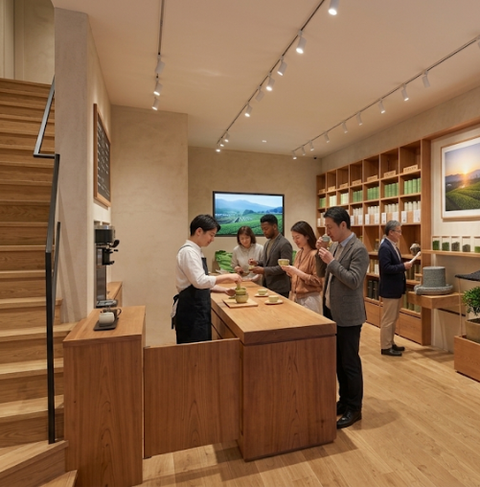
Up until now, our flagship store in Wazuka has focused on deep, immersive farm experiences such as plantation tours and overnight farm stays, with our subsequent touchpoints existing primarily online. The upcoming Uji location will bridge that gap. In addition to our retail offerings, the space will feature a counter-bar serving single-cultivar matcha lattes, traditional usucha (whisked thin matcha), matcha soft serve, and casual comparative tasting flights. Occupying a three-story building, we will initially launch on the ground floor, with plans to expand onto the second floor in the future to introduce reservation-only guided tastings and a private member bar.
Our greatest challenge with the Uji store is conveying the essence of our "Estate" philosophy without the tea fields and processing factory physically surrounding the guests. To bridge this divide, we are developing engaging visual guides and a detailed diorama that captures the unique topography and environment of Yubune. Furthermore, we are dedicated to curating an approachable tasting service that invites customers to experience the sheer depth of single-origin and hand-picked teas as pure usucha, alongside modern favorites like lattes. Our goal is for the Uji store to serve as an accessible gateway: inspiring visitors to journey out to our farm in Yubune, while providing a welcoming hub for those who already love d:matcha.

EU operations update
We would also like to share a recent development regarding our European rollout. Our initial commercial shipment successfully landed in the Netherlands. However, despite preparing, submitting, and declaring all required documentation strictly in accordance with organic regulations (including compliant commercial invoices and the EU Certificate of Inspection, or COI), a clerical error occurred during DHL's local customs clearance, resulting in the consignment being mistakenly cleared as conventional (non-organic) product. Our local team is currently working directly with the authorities and carriers to resolve the issue.
While unexpected administrative hurdles can arise even when every correct protocol is followed, we take this as a valuable operational lesson to reinforce our logistics framework and ensure smooth, resilient EU operations going forward.
02
Abandoned Tea Fields

Driving into Yubune, it's easy to think every hillside here is tea. While indeed, many fields are manicured into perfectly green rows, look closer and you'll see that others have gone soft at the edges. Bushes taller than a person, vines and weeds climbing through them. Those are fields nobody tends to anymore.

About 200 people live in Yubune, and most of them are elders. Many, perhaps most, of these elders are tea farmers who farmed the same plots their whole lives, and so did their parents before that. Tea, however, is hard work, and becomes especially difficult as you get older. In Wazuka especially, it means pruning, weeding, fertilizing, shading and harvesting by hand, on slopes, year after year. When a farmer becomes too old to care for their field, there is often no one left to take over, their own children having gone to the city for better opportunities. And when this happens, the field is simply… left.
What happens to a field left alone
The tea plant, while commonly looking like a small bush, is actually a tree. The flat or arched waist-high rows we picture are the result of careful cultivation and regular pruning. Leave a field alone for a few seasons and the bushes start growing upward again, spreading their branches towards the sun. Weeds and vines move in, and the forest slowly takes the field back. After a few years you could still see the initial rows, but nobody could realistically harvest tea from it.
Yet the bigger loss, perhaps, is what the farmer knew. Tea farming knowledge is only learned through years of practice. Reading a tea field is not a skill one can just acquire, and you won't find it written down. It lives within the people who work the land, and when a field is abandoned, that knowledge usually goes with it.
Oftentimes, when we've asked our elder neighbors what they are most worried about, it's losing Yubune's beautiful landscape and letting it all deteriorate. We're hoping to help with that.

What we're doing
Our team of six all live here in Yubune, and our work is built around keeping these fields alive. Tea is the heart of the revitalization ecosystem in our countryside. Over the years, seven farmers have trusted us with their fields. Together we've brought about seventy percent of Yubune's farmland back into cultivation. We farm it all organically, to give back to the land rather than just take from it.
We're also trying to preserve our village and its knowledge, not just the land. This means practicing traditional methods of tea farming, methods our elder neighbors and their parents and grandparents before them knew and used. We handpick tea in traditional gardens alongside our expert grandmother neighbors, and next year, we will shade some of our fields using reed-shading, a traditional method of shading almost unused today.
Every season we learn a bit more, and we hope to pass it on.
What we can't do
We can't save every field. There are only so many hands on our team, and more and more fields are being left behind as the village ages. Some will go back to the forest surrounding our valley, and while that is a poetic way for it to end, it is still an ending.
But every field we can keep means a little more of Yubune stays the way it is. When we asked our neighbor, Sugimoto-san, what she hopes for the future of Yubune, she said she hopes we will preserve the beauty of the tea fields and pass Yubune's environment on to future generations.
Where you come in
All of this is possible because of the tea itself. Every cup of d:matcha you make, every visit to the farm, and every friend you tell about us helps keep a field in Yubune growing, helps us plant new ones, and lets us invest directly back into our village. Thank you for being part of our ecosystem.
03
The Color of Matcha

Hello everyone!
Lately, our sweets kitchen has gotten quite busy. Production has kicked off for our butter sandwich collaboration with "Matcha Lover," overlapping with the making of our new deep-roasted hojicha desserts. There is only a little time left in the year now. The rush leading up to year-end will continue for a while, but I plan to stay focused and give it one final push right to the end!
Today, I'd like to share some personal research I did on how the color of matcha sweets changes, what causes it, and how to counter it.

Why matcha changes color
One of matcha's defining characteristics is its vivid, beautiful green. This shade comes from a pigment called chlorophyll found in the tea leaves. Chlorophyll is essential for plant photosynthesis and gives matcha its uniquely striking color. However, matcha is sensitive to light; prolonged exposure causes its hue to shift gradually. Ultraviolet rays and intense light in particular accelerate the breakdown of chlorophyll.
When chlorophyll degrades, that bright green fades away, often shifting into yellowish, olive, or brownish tones. Light exposure also triggers oxidation, which can compromise not only the natural color, but the aroma and flavor as well. Because matcha is a delicate ingredient whose visual appeal and overall quality are so easily swayed by storage conditions, it requires careful handling.
For matcha desserts, visual beauty is just as crucial to their appeal as taste and scent. A vivid green instantly evokes the fresh, authentic essence of matcha. If the color dulls, customers might perceive the item as stale or low quality, even if it still tastes perfectly fine. This discoloration is especially noticeable in cakes, baked goods, and cream-based confections.
How to keep it green
To preserve the color and flavor of matcha as long as possible, managing light, oxygen, temperature, and humidity is key:
- Light: Keep products away from direct sunlight and harsh artificial lighting. For items displayed in showcases for long hours, the type of bulb and the angle of exposure require close attention. You might notice that convenience store matcha sweets often come in light-blocking metallized aluminum film packaging. Similarly, while iced coffee at convenience stores comes in clear plastic cups, iced matcha lattes often come in opaque black cups, specifically designed to shield the drink from light.
- Oxygen & moisture: Matcha powder should be sealed airtight immediately after each use to minimize air exposure. Because absorbing moisture rapidly degrades quality, keeping it in a dry environment is vital. For finished sweets, using individual airtight packaging and oxygen absorbers is an effective way to minimize contact with air and prevent oxidation.
One of the main reasons I love matcha is its gorgeous color. Green conveys natural authenticity and highlights the raw quality of the ingredient. A deep, rich green also lends a sense of luxury and refinement, elevating the visual presentation of any dessert. When crafting sweets, making the most of that signature vibrant hue catches the customer's eye and showcases the item's true charm. Moving forward, my goal is to keep making sweets that communicate the magic of matcha not just through flavor and aroma, but at first glance.
04
Ro-biraki: The New Year of the Tea Ceremony

I touched on ro-biraki (opening the sunken hearth) briefly last month, but if October's nagori (the lingering autumn season) is like New Year's Eve, it is no exaggeration to say that November's ro-biraki is equivalent to New Year's Day.
Back when I was a student, on October 31st, we would take out the tatami mat used in the center of the tea room for the furo (portable brazier), which looks just like any other tatami mat, and swap it with the tatami mat for the ro (sunken hearth). The hearth mat has a square opening cut out at one corner, measuring roughly 1 shaku 4 sun, or about 42.5 cm on each side.

Next, the rodan (the hearth basin), which holds the ashes, is set into that corner opening, and the kettle's water is boiled right there. This setup embodies thoughtful hospitality: during the cold winter months, the kettle of hot water is placed closer to the guests to keep them warm. If you appreciate tea utensils, the kettle itself is naturally a highlight, but the robuchi (hearth frame) placed atop the basin is also exquisite and well worth admiring up close.
What everyone looks forward to the most is kuchikiri (breaking the seal of the tea jar). This is when we finally retrieve the tencha harvested in the spring, which has been sealed away in jars to mature slowly. The leaves are ground on the spot using a stone mill, allowing everyone to enjoy the freshest possible matcha.
Arrangements and settings
Sweets
Inoko-mochi (wild boar piglet rice cake) is the preferred confection. It is primarily made using autumn ingredients like adzuki beans, black sesame, and walnuts. Small and rounded in shape, it is typically styled to resemble a young wild boar. As for its origins, lore from China held that eating these cakes during the Month of the Boar (around modern-day November) would ward off all illness; this custom was transmitted to Japan sometime during the Heian period.
Auspicious zenzai (sweet red bean soup with mochi) is also favored, as adzuki beans are believed to promote good digestive health.

Utensils
Utensils known as the Sanbe (the "Three Bes"), an auspicious trio consisting of Oribe, Imbe, and Fukube, are popular choices for this season.
- Oribe-yaki: Produced mainly as part of Mino ware (Gifu Prefecture), this style features a vivid copper-based green glaze (dō-ryokuyū) with a characteristic olive-green hue, often formed into unconventional, original shapes and designs. As someone who loves green, it is an absolute favorite of mine.
- Imbe-yaki: Also known as Bizen ware (Okayama Prefecture), it eschews glazes entirely, letting you appreciate the raw, natural essence of the unglazed clay.
- Fukube: Referring to gourds (hyōtan), these are primarily used as flower vases (hanaire).

Tea flowers (chabana)
For me, it is no exaggeration to call the camellia (tsubaki) the undisputed king of flowers during the sunken hearth season.
05
Field Notes: Autumn Pruning

Autumn pruning (aki-sentei or aki-seishi) is a vital task that significantly impacts both the yield and quality of the following year's first flush (shincha). After the second harvest ends in July, the tea buds across the surface of the field continue to grow throughout the summer and into autumn. As a result, the canopy becomes bushy, unruly, and overgrown by late autumn.
The goal of autumn pruning is to trim and shape this overgrown foliage so that next spring's first flush comes in evenly, maximizing both yield and quality. Smoothing out the canopy surface creates a clear dividing line (the plucking plane) between new shoots and older growth, ensuring that only the tender new buds are harvested when the time comes. Without this step, mechanical harvesting of only the fresh shoots would be impossible; it is an indispensable practice directly tied to crop volume and leaf quality.
When carrying out this work, there are three critical factors to keep in mind: the smoothness of the plucking surface, timing, and pruning depth.
1. Smoothness of the plucking surface
A smooth plucking surface is the most important element for establishing a clean separation between old foliage and new shoots. If the surface is uneven or rough during harvest, it leads to reduced yields and causes tough, older leaves to get mixed into the harvest. In some cases, a follow-up leveling pass (narashi) is carried out after the initial autumn pruning to achieve an even cleaner finish. For sencha, where buds are harvested while relatively young and tender, this leveling pass can be particularly essential.
2. Timing
Tea bushes stop growing entirely with the onset of cold weather between late autumn and winter. Pruning right at this transition allows the plucking plane to remain sharp and well-defined through to the spring harvest. If pruned too early, however, new lateral buds will sprout before winter sets in. This phenomenon, known as late re-budding (sai-hōga), wastes the tea plant's stored energy reserves, diminishes bush vigor, and forces a second pruning, ultimately reducing yield and quality. Conversely, pruning too late leaves fresh cuts vulnerable to frost damage and winter cold injury, making precise timing essential.
3. Pruning depth
Pruning depth determines exactly how far down the canopy is cut, making it the most critical consideration during autumn pruning. If cut too high, the spring shoots will flush unevenly, creating wide variations in quality from bud to bud. If cut too deep, shoot elongation will be stunted. Cutting to the exact proper depth is essential, standing out as the single most vital factor among the three.
Crafting a pristine plucking plane, timing the cut to perfection, and dialing in the correct depth are the keys to maximizing yield and quality. In tea cultivation, few practices demand this level of precision and care.


06
My Journey at d:matcha

This month marks my last with d:matcha. I started as an intern and came back on a temporary work contract. I had time, and a strong desire to pursue my interest in tea, so I thought, why not work with them!
d:matcha has a small team running so many things! Working here means doing different tasks through the days, the weeks, the months… the schedule largely adapts to the season. Spring is mostly about the first harvest of the year: shading the tea trees, weeding, harvesting, and running the factory. There are many tours too.
Summer is more about field maintenance and factory work: mixing tencha we receive from other farmers, weeding, cutting tree branches that grow over our tea fields… We harvested tea from a few fields, but nothing like spring. Summer work was so physically exhausting, so hot… It was a real challenge.

Fall is tour season! We have to do some farming, like trimming tea trees, but most of the work is about operating the tours that happen almost every working day. This is more about coordinating teamwork to make sure all goes smoothly, and it usually does. I also pack a lot of sencha and matcha.
It doesn't get boring working here! Daiki-san and the team trusted me with a work contract and I am really grateful I was given this chance. For me it was definitely very challenging, but I am glad I decided to come back. I learned a lot about myself, and I appreciate working with the d:matcha team. I needed this time and experience to reflect on myself and what I want to make of my time. Next, I will go back to France, rest, enjoy my family and friends, and follow the path that opens to me!
This is it for me. All the best to all of you, and thank you for following the d:matcha adventure!
07
Creating Tasting Notes for Matcha

This month, I worked on creating tasting notes for all of our different matchas. The process started with some groundwork. To identify and describe different flavours, you first need a set of references. So, the first thing I did was create a flavour wheel. Of course, there are already many available, but none of them quite met our specific criteria.
To visualise the different flavour notes in a clear and structured way, I decided on eight main categories that give a general idea of the tea's taste. Each of these categories also has several subcategories. For example, the category Fruits includes citrus fruits, berries, tropical fruits, and other fruits. Each of these subcategories is then divided into actual tasting notes, such as lemon, cherry, or strawberry.

The actual tasting process consisted of several stages, including regular tastings, comparative tastings and, in some cases, even blind tastings. To ensure consistent results, I prepared all matchas in exactly the same way: 2g of matcha with 80ml of hot water (90°C). I also tried to whisk each one in the same way and for the same amount of time (15 seconds).
The tasting notes should reflect the usual drinking experience, so I started by taking note of the tea's aroma. I often found that the smell was quite different from the actual taste. Next, I focused on the tea's physical characteristics, or mouthfeel. This includes aspects such as umami, bitterness and astringency. And finally, the most important part: the actual flavour notes. Depending on the cultivar, these can differ quite significantly.
Since matcha has such a rich and complex flavour profile, pinpointing individual tasting notes can be quite challenging. Nevertheless, I did my best to identify at least a few notes for every matcha. The final step was to assign a value to each category. This required quite a bit of comparative tasting, and the results may still be adjusted in the future.

One very important thing to keep in mind is that taste is highly subjective. Some people might pick up floral notes where others find fruity ones, or woody notes instead of nutty ones. Ultimately, I hope these tasting notes will serve as a general guide, helping to highlight the differences between the various cultivars and giving everyone a better idea of what to expect from each matcha.
